

Table of Contents
This isn't a newsletter, more of a personal update I thought you might be interested to know about. I'm always curious about others' tech stacks ... so if you fall into that need too, here is an update on my own technology usage for 2026: The-year-where-I -hand-in-my-PhD.
An Overview
Whilst I use other software on occasion, this is a list of the tech workhorses I use every day, in no particular order:
- Microsoft Office (Outlook for email and calendar, Word, Powerpoint, Excel)
- Obsidian
- Zotero
- RStudio
- Claude
- YouTube Music
- Ghost
- Chrome
- reMarkable
I have slim-lined somewhat in the last six months. I'm also not using the full suite of options that each software provides. I'm very much now in the KISS - Keep It Simple Sweetie - camp. Or at least, 'build as you go'. Lets now break them down by function so you can see how they all fit together.
Time and Task Management
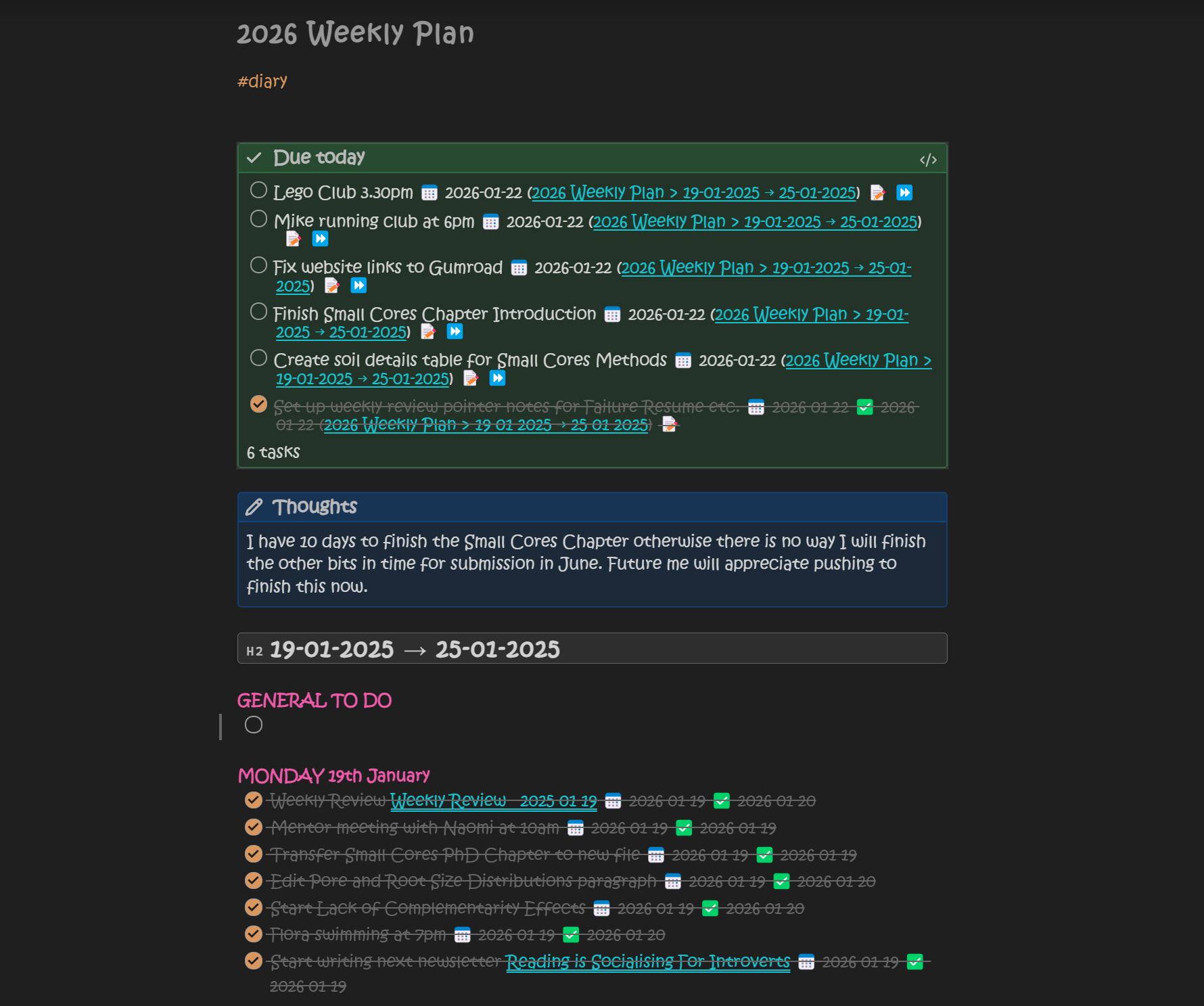
I was always quite adamant that tasks and notes remain separate, and they sort of still are, but not quite. Here is how it fits together:
- Outlook - everything important goes in the calendar and its shared with my husband; if it ain't there it doesn't happen/I forget
- Obsidian - I keep a single note with a more detailed weekly/daily plan 👇🏻
Finding Information and Sources
Chrome is my go to web browser. I have RSS feeds set up for most journals in Zotero. They don't really work as smoothly as I'd like. Journals that don't have this functionality come into my inbox and I think I might actually prefer this option. At the time I set them up into Zotero I wanted to keep them out of my inbox but the RSS feed doesn't function how I like so I may switch.
I'm increasingly using Claude for finding out basic information outside my area of expertise to get the basics about the topic. Whilst I do ask Claude for references, they often aren't suitable, are wrong and very limited in scope. Because it uses a 'hive mind' approach it can actually be quite interesting to see where it derives sources from. This can actually be more interesting rather than useful per se, highlighting gaps, misunderstandings and how to ensure any of my future papers are cited and interpreted properly...
Generally I'll use Clarivate's Web of Science or Scopus if I need to do a comprehensive literature search, 'cited by' features on article pages for new papers, or probably most commonly, the reference list of articles themselves. Just depends what I'm doing and what I need to find. There is also the library for the older stuff.
LinkedIn is also really helpful - please share your papers (and why I should read them 😉).
Source Processing and Note-Taking
This is probably the part where the 'magic' happens, but it takes years to create this 'magic'. I still consider myself an apprentice. Here is my process I've developed over the time since I started my PhD and I know works for me:
- Written sources go into Zotero as a reference. Talks and websites just go straight into Obsidian. Hand-written notes go in as PDFs too.
- I have a reference note named via citekeys (authorlastname-year-FirstSecondtitlewords) for each source in Obsidian - ported in via the 'Zotero Integration' plugin - and take notes in there. Quotes and notes on the source go here, along with thoughts. If I don't have much time it stops here and I just link to a few key notes.
- Ideally, these then get processed into 'Encyclopaedia' notes which are effectively just topics and collections of research themes (think Wikipedia) and 'Hypothesis' notes which I am actively building evidence for (think my life's work!). This takes a lot of time so it doesn't usually get done as rigorously as I like, but that's OK. What matters more is that I can find it again. Ironically if it does get done it actually saves time in the longer run because when it comes to writing, its more or less a case of copy and paste. This is the 🪄🧙🏻♀️.
- When encyclopaedia notes get unwieldy they get broken down into attributes and these follow the same format (e.g. history of, things that it influences, things that influence it, how it forms):
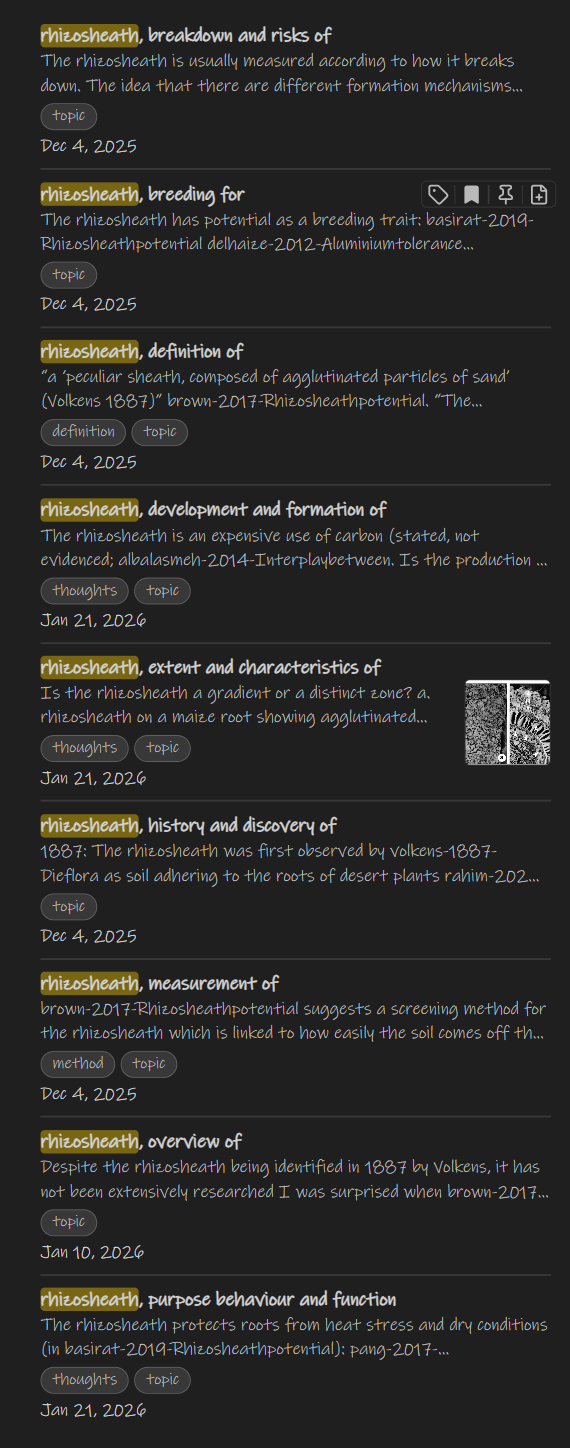
It has taken years for me to work out that this structure works best for me. For me, the central ethos is consistency: consistency in naming files, consistency in how things are broken down into subjects, consistency in updating, consistency in method and consistency in how they reform. This doesn't happen overnight, nor does it ever 'finish'.
Writing
Writing TBH happens in too many places, but there is not a lot I can (viz I'm willing to) do about that at this time. Writing happens on my reMarkable e-ink table, Obsidian, here on Ghost, LinkedIn and Word.
- reMarkable - out and about notes, notes on books I'm reading; for the most part this has replaced physical notebooks
- Obsidian - drafts, thoughts, knowledge base, hypotheses
- Ghost - essays, newsletter, guides
- LinkedIn - thoughts, summaries
- Word - PhD, shareable documents
Socials and Communication
Having tried to manage multiple media streams, I cut back last year to focus on Ghost and LinkedIn. I'm sorely tempted to return to Substack and start up properly with Bluesky but I have to be realistic about my time. Longer waffles go on Ghost and the shorter stuff on LinkedIn.
I deal with all my email through Outlook. The obligatory Powerpoint for presentations.
Data and Statistics
Data goes into Excel where I try to keep one file for all processed/analysable data in an experiment. Separate archive files are kept of the unprocessed data. Statistics are done in RStudio with the help of Claude to write code.
Going to be honest, I increasingly use Claude for code. It allows to me to focus on why I'm using the statistics, choosing the best options, making sure its thorough and well commented, rather than spending hours trying to work out how to change the direction of an axis or colour by factor. I know this means my actual learning to code beyond the basics I understand already will be limited in future, but that's a trade-off I'm willing to accept in balance with doing more rigorous statistics and spending more time understanding the output. To me the latter is more important than the former. Others will disagree. I agree with your disagreement, but we all have different priorities and finite time.
I back up my data regularly using a combination of OneDrive, Google Drive and multiple hard-drives.
Enjoyment and Focus
There is a 50% chance I will be listening to music whilst I work so that's why the Tube is on there. I like a mix of instrumental - cello, piano - country and singer-song writers. Very occasionally I'll listen to rain. I pay for a subscription because I find adverts very distracting when I'm working. Plus having video too means I can keep up with my favourite YouTubers; Living Big in a Tiny Home, James Hoffman, Tara Brabazon... and if I'm feeling really 😮💨😱 then some replays of somebody's Got Talent ticks the brain-dulling box nicely!!
And there you have it - a very quick overview of my 2026 tech stack! I've probably missed something important out but 🤷🏻♀️ ... I'd love to hear about yours! Feel free to share any links or lists with me.
Until next time, keep consistently iterating,
Annette
Comments