

Table of Contents
It’s been an age since I just wrote. Perhaps I am getting inspiration from Holly Ringland’s ‘The House that Joy Built’ or maybe there is a need for some creative work to emerge. I even wrote part of my fiction book yesterday whilst waiting for the school bus. It was bad, but it got written. That’s two distinct problems. Another would be the 4 weeks until I need to submit my thesis.
Writing like this post therefore feels a little indulgent. However it does highlight a particular challenge that I have: a constant questioning as to what I am working on in the moment. Reading around my subject area feels equally indulgent. Yet both are central skills in research work. I do not get better at either without practise. In the wider context of the research world, should I instead be at the lab bench, setting up experiments and poring over the results with perfect statistical precision? Or in the natural world observing? Well, yes, that is a big part of the science I do. We cannot have new science without new work. But how do I know what science to do if I do not read what has gone before? How can I tell people about my science if I cannot write about it well? Why does something that feels indulgent always have an undertone of feeling ‘wrong’? It’s like my past has conditioned me such that I am not permitted to enjoy what I do. And if I do enjoy an aspect of my work, it’s probably a sign that I’m putting off something else I don’t want to be doing. When did that happen?
I don’t know about you, but I almost always have this sense of "I should be doing something else". And even if I’m working on 'the most important thing', then my internal voice changes to: “I should have done this earlier” or equally, “I don’t have enough time to do this properly”. What I need to focus on are the occasional snippets of time when I do just simply enjoy what I am doing in the moment. They are rare, but they do exist. Sometimes it's when I'm out in the field and the sun is shining and sometimes it's when I'm tucked up in bed at the end of a long day.
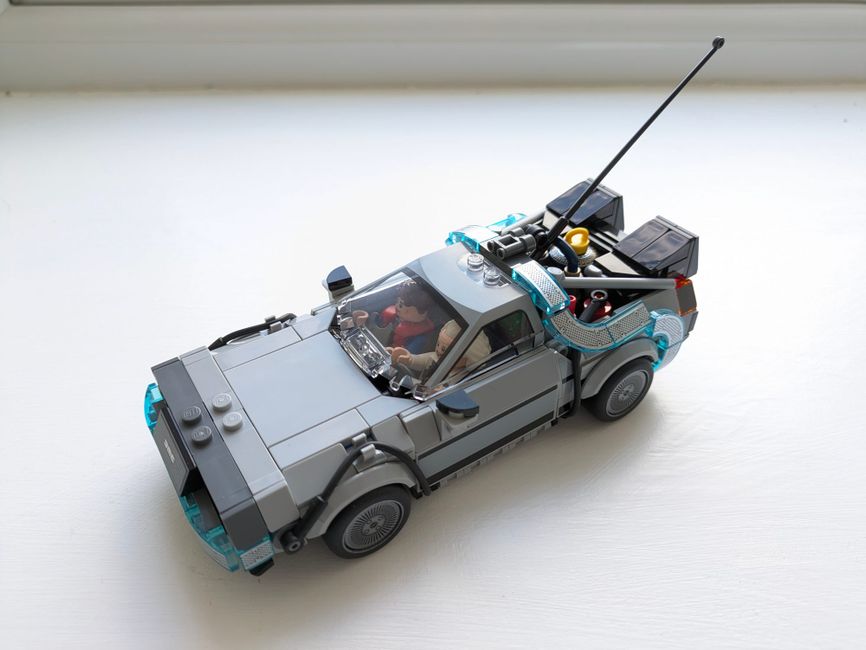
This weekend, I was privileged to have this experience, the first time in who-knows-when. I bought myself a Lego set; the Back to the Future car with Marty and Doc mini-figures, in case you are wondering. I was brimming with excitement about building this car and having a quiet moment to myself. I set myself up in a cosy space, laid everything out and pored over the images on the box. I opened the first Lego packet slowly, deliberately, and I felt the pieces, enjoying their pristine forms, colours, and textures. I turned to the first page and carefully put the pieces together. I didn’t have to think about being creative, yet I was still engaging with the process of creation, even if it was just following a set of instructions. My mind switched off, as it enjoyed putting the pieces together purposefully and one-by-one. After finishing later that day, I sat the car on my desk. I wheeled it backwards and forwards; as close a precursor to play as my adult self was willing to go. I left it with the figures set up in a pose so that when I returned I could appreciate the scene I found before me.
As I return to my computer this morning, Marty and Doc are trying to fix the flux capacitor. A small point of humour that recognises that science goes wrong. A lot. It might seem childish to indulge myself in such frivolities when there are much bigger world issues at stake. Yet this Lego car represents a reconnection to my inner creative, and permits me to be curious, relax, and enjoy the fun in life for just a moment before I start work. Even the idea of the car itself symbolises our past and present and future, and what happens when scientific creativity and a unique and eccentric mind come together. ‘Value’ is not just peer-reviewed evidence, but movies and toys and play. At Lego's core is pure indulgence, constructed with capitalism and unrecyclable plastic. But on the outside, it’s a toy that has not changed since its conception by Ole Kirk Christiansen in 1932. It was built right the first time, and it was built well, and this legacy cuts across generations. It is a scientific masterpiece of engineering, creativity and passion.
This is what I strive for as a researcher, but equally there is negative conditioning at its core that will always be there. It is this conditioning that feeds the voice that constantly questions what it is I am doing in the moment. Science is, currently, at its core a noxious mix of funding challenges, redundancies, overwork, and of course, unrecyclable lab plastics. But on the surface, I can indulge in its perks, like writing, reading, and tinkering with lab-based toys, all in pursuit of great scientific discovery. We all seek our own version of the Holy Grail. Perhaps I should learn to lean into this more. The step-by-step guide does not exist, so I must 'trust the process' to show me that the reductionist components of my work will lead to something holistic, eventually. Like Lego, science has negative things with real consequences at its true core that can make the fun things seem frivolous and childish. But when the parts come together across time and space, the end creation, the ideas, and the community override them, and show us that not all is bad with the world.
Keep building,
Annette




Comments