

Table of Contents
I'm an introvert. Perhaps no surprise there for my regulars. And I love reading. I particularly love hearing how people - through writing specifically - 'see' the world. Part of that is being able to hear their voice in their writing. The second part is then the ability to listen deeply to that voice. In essence it's the best part of a conversation between two people that is particularly suited to more introverted people like me. However the more I read, particularly online, the more difficult I'm finding it to find real voices amongst the noise. And with that comes the increasing challenge of being able to listen.
This week's post discusses how, I think we have responsibilities as people, to deeply engage with the writing-reading process. We should ensure we use our own voice when writing and take the time to listen deeply to that voice.
Reading offers an ability to be 'social' without all the draining, real-life stuff in the background
If writing is thinking, then reading is listening. By this premise, deep reading is deep listening. I feel reading is a method of socialising for introverts and the neurodivergent, because it is a quiet, safe space where we can listen to the voices of people taking the time to say what it is they need to say. For a writer it is an opportunity to have all eyes and ears focused on you and your skill is directly proportional to how long you can hold that attention. If done well, writing captures all that emotion and feeling around how the writer envisions saying it. As a reader, reading immerses me in someone else’s world using their own words and voice; see it how they see it, and hear it how they hear it. I get to eavesdrop and I get permission to do so.
“Reading is just as much of a creative and imaginative act as writing, because a story isn't a pill you take to feel certain feelings and think certain thoughts as prescribed by the author - it's one human being engaging with another human being in order to imagine the world of a third one.” Joe Norman, The Super Tutor (2019).
Reading is just a one-sided conversation
As an introvert, reading to me is socialising; it’s a conversation by which someone - the author - is talking to me. And I listen. Intently. Is that not the two critical elements of having a good conversation?
“Turn taking, active listening and space-giving are vital components of an exchange, ones that should be regarded as sacrosanct if we are to truly benefit from time spent together.” Nihal Arthanayake in ‘Let’s Talk’
I might not be able to voice my thoughts in the moment, but as authors and readers increasingly take to social media, it’s pretty easy to continue the conversation on our own terms. Authors with whom I have commented on their work, very quickly jump into my DMs to share their thanks. It’s a warm space of listening and responding, perfect for introverts like me.
Reading is just a way of having a conversation without the other individual present. In that sense it is a particularly magical form of communication because if done well, it is clear and unambiguous. But done wrong and out of context, or if you ignore it, it gets messy very quickly. In ye olden days when we communicated using smells, markings and eventually pictures, mis-reading a sign could mean death. Admittedly it's slightly less risky for readers nowadays, but cancel culture is a very real thing. By reading widely we can get a much more detailed picture of a person than a one off, often out of context, comment.
This is why we must also listen deeply.
Reading is deep listening
Reading puts us in the unique position where we can deeply listen to what the other person has to say. How often does that happen in real life? (I mean you can even listen to dead people - how cool is that!?) If you are like me and only have a certain amount of social battery, books and essays are a way to listen without all the overwhelming real people stuff. I can just focus on what is being said.
Reading is also an opportunity for me to take notes while I read; barring lectures and presentations, how weird would that be in a real life situation? By writing verbatim or paraphrasing what the writer is saying, not only am I confirming that I have heard what they have said, I can also note down my response 'in the moment', allowing me to explore the potential for that conversation to be two way.
"To be able to understand people and be present for them in their experience - that's the most important thing in the world." therapist and author Mary Pipher in 'How to Know a Person' by David Brooks.
Of course, ironically, today's 'connected' world brings us new challenges in what can be quite an intimate relationship between writer and reader. We have responsibilities both as writers and as readers yet we are increasingly shirking that responsibility. We have a current situation where information is overwhelming and time is limited. It's only natural to want to shortcut and hasten the process of communication, but at what cost?
As the speaker, writing comes with a responsibility
My job here, as a writer and you as the reader, is to allow you to eavesdrop in on my world with all its sounds and colours, not to convince you to live it my way.
"If the outcome you desire from a conversation is for the person you're speaking with to change to be more like you, then it should be self- evident that the conversation is doomed." Nihal Arthanayake in Let's Talk.
There is often a vulnerability associated with writing. I get it. With every word written there is little bit of you left on the page. We're afraid we might not be able convey what it is we really mean or want the message to be. In sensitive moments, words and voice matter even more. What if we are misconstrued? What if we say something stupid? Therefore writers have a responsibility to convey messages and meanings clearly. And that is difficult at the best of times:
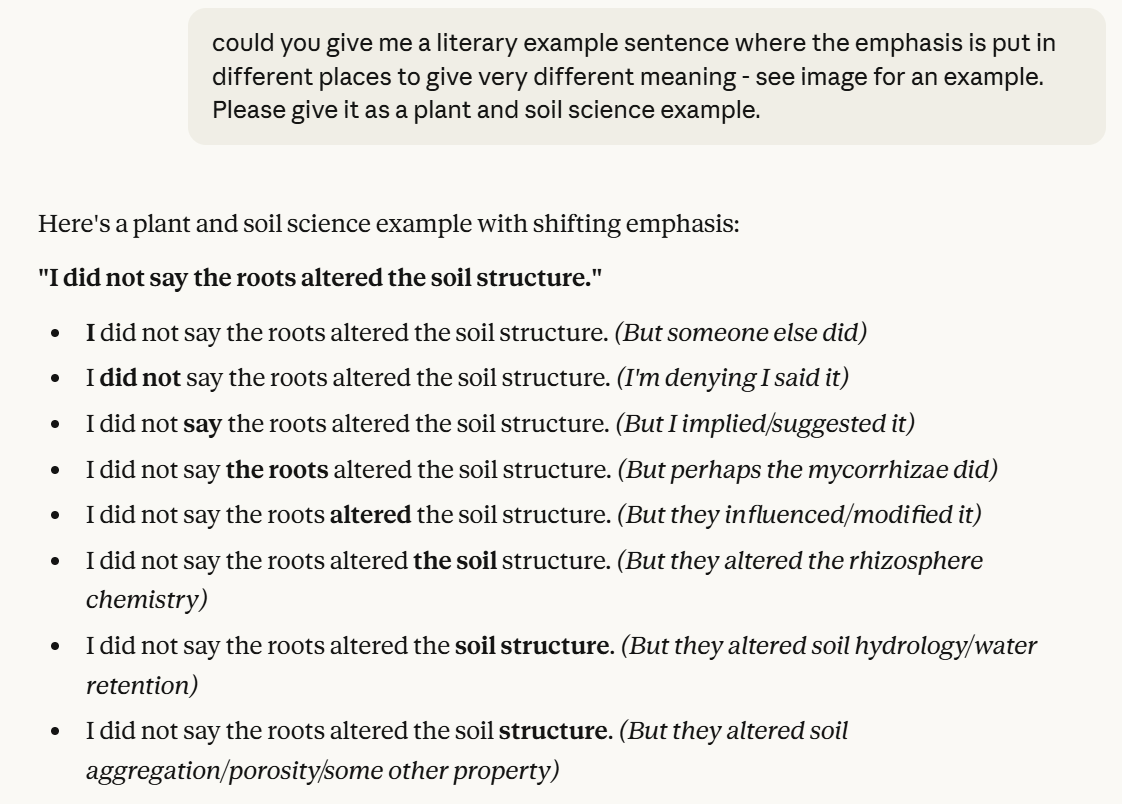
In this situation, the one-sided nature of the conversation might not fully convey what is actually meant unless the writer is able to use artful sentence structure and formatting to convey emphasis. This example might seem obvious, but with the complex jargon and long sentences used in academia it can quickly get confusing. And when something becomes challenging or time-consuming, what do we do? We look for ways to make it easier and faster. Cue AI.
But why does having AI help matter?
To me it comes down to voice and identity of the writer; writers have a responsibility to be authentic to their lived experience and imagination. In every piece of writing there is an invisible layer of trust woven into the words. You can't see it, you can't even write it in specifically -'trust me, I'm a doctor' - but it's there. AI doesn't formulate this layer. It can't. It isn't you.
Am I trusting you or am I trusting you with an LLM doing your work in the background? I admit that I have used AI to help me write some blogs prior to this one. But I don't any more, now that I have realised that it takes away this invisible mesh.
Voice is increasingly downing in noise
I only have to read "it's not that..." and I feel my hackles rise up. I even just read it in a book written pre-AI LLM and I shivered inside. Reading now comes with a level of discomfort that just didn't exist before. Certain words like 'rare' and 'opportunity' and 'shine' and others that are just uncommon enough in usage up until now cause me to raise an eyebrow. Even the way sentences are constructed and text is formatted can make something inside me stir that I don't like. The more I read social media, the more I get annoyed about reading AI generated, and even facilitated posts.
As an introvert, that background distracting, decoding stuff that occurs in real life, is now creeping into my safe reading space. There is now another layer of communication I have to decode before I can understand and engage. It almost feels ... hurtful.
Sneaky writing irks me
Whilst the issue of AI-generated text is rampant in social media, the issue is in books and the primary literature too. Have you ever read an AI-written (and/or drawn) children’s book? OMG it’s cruelty to children. Or a paper with a made up citation? Cruelty to scientists!
An increasing prevalence of ghost writers, however well-intentioned they might be, just makes everything more sneaky. I don’t mind if someone else writes about you, I don’t mind if someone (or AI) helps you a bit when you get stuck the same way an editor might, but I don’t like it when someone else writes for you under an invisibility cloak. It’s taboo in scientific publishing and it should be taboo across all writing; money and status shouldn’t be able to buy you this privilege. AI tools fall under that same umbrella. It's the sneakiness that irks me and its decoding that sneakiness that is increasingly demoralising and tiring. Whose voice is it I'm listening to?
When I look at reading through my introverted social lens, I’m beginning to find it hurtful when people feel the need to use AI to say something either: a. they can just write in their own words but with less clarity, or b. they don’t really understand and want to sound knowledgeable and insightful. Perhaps hurtful sounds strong, but when I read, I want to read something genuine. I want to listen to what you have to say. I don't care that it has spelling mistakes, I don't care that I will only hear from you once a fortnight, I don't care if it's short and pithy or long and rambly, and I certainly don't care that it reads like you haven't entirely worked out what it is you want to say. Kind of like my writing...
AI teaches us to write in a way that appeals to the masses but talks over our individual voice. Even the best speakers in the world will tell you, that even in presentations to 1000s of people, you should speak as if it was to just one person. Because they understand that people like to be seen as individuals and when they do, they are much more likely to listen.
"A good lecturer speaks directly to and watches the response of single identifiable people, instead of doing something cliched, such as 'presenting a talk' to an audience." - Jordan Peterson, 12 Rules For Life
As the listener, reading comes with a responsibility
What if I now said that you have a responsibility as a reader? If the writer has a responsibility to be clear and engaging, what if you had a responsibility to listen to what they had to say?
“Books are a dialogue between souls. All the untapped energies in great novels should not lie coiled in the pages in vain. All the agony and effort that goes into initiating this dialogue between souls should not be in vain. The reader should bring the best in themselves to meet the best in the writer's work." - Ben Okri (A Way of Being Free; The Joys of Storytelling I)
Whilst there may be less dramatic consequences for many of us nowadays as readers, writers risk their pride, their reputation, their bottom-line and even their lives to communicate their lived experiences. Do we not owe it to them to listen? In the same way we have a responsibility in a physical social situation to listen, we have responsibilities as readers too.
But I can't listen to everything?!
It's fair that we can't listen to everyone and everything. I get it. There are too many great books in the world to read one that doesn’t connect; that number is only increasing. I will be the first person to say that if you aren’t enjoying a book - if it doesn't resonate with you - then to stop. Sometimes its not interesting to us. Oftentimes its badly written or written in a way we can't as yet understand. Sometimes it lacks the novelty factor because it's so similar to how we see the world that it feels like we are looking in a mirror. Or they might not be showing me their world, they might be telling me how I should see it. I take this as an indication that the author isn’t open to a two-way conversation with me.
There are plenty of books I don’t connect with, but others rant and rave about. That's a good thing.
There are methods of reading more sources, more quickly. We can then improve our filtering and selection process of those we want to spend our quality time with. What we don't want to do, is to get something else to do that for us.
Deep listening as a reading skill is becoming lost to AI
I get why people want to circumvent the reading process and do things more efficiently. The problem is not necessarily how we extract information to be aware of what's going on around us, it's the skills we lose in deep listening and forming a deeper understanding of someone else's world or work. By extracting information we glean knowledge and by listening we develop understanding.
When I sit down with a book, the world slows a little. I can immerse myself in someone else’s world. As Aneurin Bevin would say, “I am seeing their truth”. It’s a connection that cannot be replicated in any other way. But deep reading I fear, along with writing said book in the first place, is a skill we are losing. The world is increasingly loud and busy. Voices are increasingly marred and flattened by AI. Distractions abound, and deep listening gets harder and harder. Information is everywhere. And what happens as we try to deal with information overload? We tune out and stop listening. And we seek more efficient ways of finding and dealing with the information that is relevant.
Together these make for an increasingly discombobulating mix of both losing, and making it more difficult to use, deep listening skills. For introverts and neurodivergent people specifically there is an increasingly deeper layer of de-filtering that must be done to get at what lies underneath, making reading more tiring as we decode that filter. All-in-all for someone who feels that reading is a social activity, I have a problem.
It’s why I get annoyed and concerned with AI paper summarisation tools. I understand why people use them, but it’s a very slippery slope that avoids ‘listening’. To me, listening by reading what other scientists have to say, is one of the foundational pillars of being a research scientist. Will we end up being a dangerous world of summaries of summaries of summaries...
There are some books which are quite mechanical, poorly written and can essentially end up much clearer as a short summary or blog. The author has done a disservice and tried to expand a message that would be just as effective as an essay. But the best pieces of writing cannot be read as a summary. There are nuances and critical insights. There are ways you connect with the writer that only you would, in the same way friendships cannot be boiled down to strengths and weaknesses. And there are personal experiences you have that weave your very soul together; the best books and authors never leave you. In the same way they build invisible threads into writing, they also build invisible threads within you as a person.
And it's not just AI that is the issue, because there is an incoming wave of low reading. In 2025 the National Literacy Trust reported a 36% decline in reading for enjoyment in 8-18 year olds over the 20 year survey period. Less than 1 in 5 read something every day in their free time. Meanwhile we have missed two weekly library visits and my 7 year old daughter is complaining she hasn’t got any books to read …
Write authentically and read genuinely for a great conversation
Write and read as you
Only you can create the invisible thread that is woven through everything you write. You can't see it yourself, but others do when they read it. When I read and write as me, it's a very different experience than when I involve other tools; it's a much longer, more involved process. There are many more words and there is a lot more thinking. It takes longer - waaay longer - but it feels so much more rewarding and satisfying knowing that I did, and can do, it all by myself. Equally I have to live with the frustration of moving slowly and FOMO. Find your own balance as long as it is you.
Understand the difference between knowledge, understanding and awareness
If I don't engage deeply with a text and I just glimpse into an writer's world, I have to accept that's OK in an increasingly overwhelming world. But I can't then talk about it as if I know it. It has to act more as a 'placeholder of awareness': my responsibility is therefore limited to awareness, not understanding. Knowledge comes when we apply awareness and interweave it with our own understanding. I think a lot of the (primary) literature I read nowadays is for awareness-based reading. There are very few pieces of research that I deeply understand, out with my own. But that doesn't preclude my knowledge of a wide range of topics.
Understand what role you want AI to play in your work; what you gain and, more importantly, what you lose
AI has incredible value: helping to structure, figuring out how to re-write something a bit clunky, helping you to see where the argument is lost, all amongst other super handy formulations that give us access to feedback and tuition that we would not otherwise have, unless we have money. I see AI as a sparring partner, or a coach, or a wise mentor who has lived a life different to mine. They have their own backgrounds and stories of their own. They can contribute valuable insights already understood by the hive mind. If AI has access to a lot of your writing, it might even produce something close to what you could write. But don't be fooled; that invisible thread is missing.
Ask questions; write about them and listen to what others have to say
If we aren't 'speaking' authentically and we consequently can't, or don't, 'listen' deeply, what does this mean for communication? Does it mean a concurrent risk of generalisation of voices, but with an equal amount of selective listening? Will we become too afraid to be heard? Will we lose what it means to listen to another's world? Will we lose the ability to be creative and immerse ourselves within that creativity?
Decide who you want to listen to - serendipitous methods encouraged - and give them your full attention, in the same way you would a friend who has stopped round for tea and cake.
And finally...
Make it easier
I get that people don't have time to read books. There are ways to make reading easier and more natural without reverting to summarising tools. Here is my experience: I have a 7 year old. If I sit down for 10 minutes, she comes and jumps on me. If I sit down with my phone, she asks to watch TV on her tablet. But if I sit down with a book? She ignores me and gets on with playing in her own way.
I also have about 6-10 books on the go at once - one for every mood and place! Libraries are a great way to access books for free.
Make it harder (for introverts)
Or just be more extroverted and talk to people instead...your choice... you wouldn't use AI to do that ... would you?
Until next time, Annette X
🧪 Sharpen Your Skills
- Bianca Pereira is offering the first version of her new course 'Say What You Mean' for free in return for feedback and a testimonial; sign up here before 24th February 2026
🧫 Interesting Stuff
This X/LinkedIn post from Simon raises an interesting point around how we engage with faith, truth and belief:
 Simon Maechling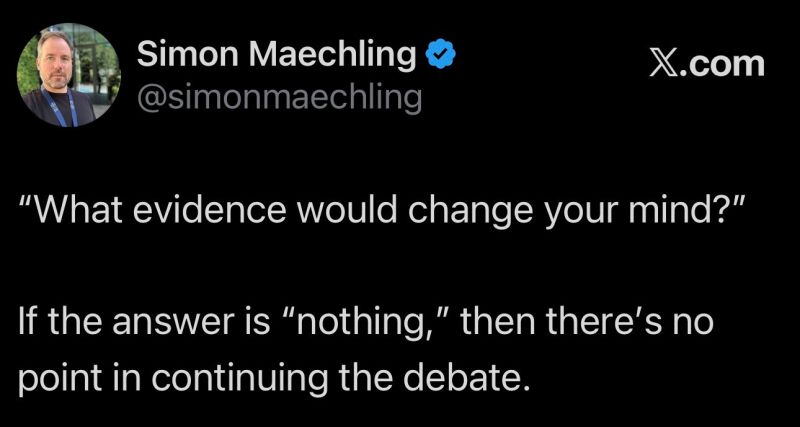
⌛ Writing and Media Updates
- I updated my Obsidian Out-of-the-Box themes post for 2026:Q1 in case you are interested in trying out a new theme
- I also wrote a post about the software I'm currently using and will see me out to the end of my PhD
- On LinkedIn: What can future you see that current you can't?; What would things look or read like if you looked at them upside down?; How to create actionable theories (Dietz, 2025; research paper summary)
"No one — not rock stars, not professional athletes, not software billionaires, and not even geniuses — ever makes it alone." Malcolm Gladwell, (Outliers, 2008)
- "David and Goliath" by Malcolm Gladwell;
- read if you are curious about how being small is not always a bad thing
- also interesting in the context of his later books in that you can see how his writing style improves over the years
- "How to Know a Person" by David Brooks;
- read if you like to understand how people work: how to 'see' people
- drops a bit in the middle; first third is the best part
- "Field Work" by Bella Bathurst;
- read if you want an insight into the realities of farming, particularly in relation to animal production
- not the most riveting book in the world, but the characters and stories are interesting
I can't say how much it means to me for you to subscribe and read this newsletter. Thank you, as always.
 Annette Raffan
Click on this link for a one off way to support my work here.


Comments